How to Use the Best Screenplays of 2020 as a Writing Guide
I’m a visual learner. Sometimes things don’t immediately click in my brain when I read an explanation or someone is teaching me something. But, if I can look at it - see it in action - then I get it right away.
There are tons of screenwriting books out there that are actually pretty great for helping to learn and hone your craft. There’s also a lot of bullshit. One of the things I struggled with in the beginning was wanting to make sure that I didn’t come across as an amateur even though I was one. So, I read almost anything I could get my hands on.
Unfortunately, there isn’t one comprehensive tome with everything you might need to learn. So, I did the next best thing and learned from what was already out there.
If I had a scene I couldn’t get quite right or just flat out didn’t know the proper way to write; I thought of a movie that did what I was trying to do and printed out the script. If I wondered how to write certain dialogue or narration or the exchange of a phone call, I looked up a script and printed it. I could visualize the scenes in a movie, so I was able to utilize the script as, essentially, a textbook. It’s like getting a masterclass in screenwriting from some pretty heavy hitters.
I think this is one of the most underutilized resources for screenwriters. And it’s free.
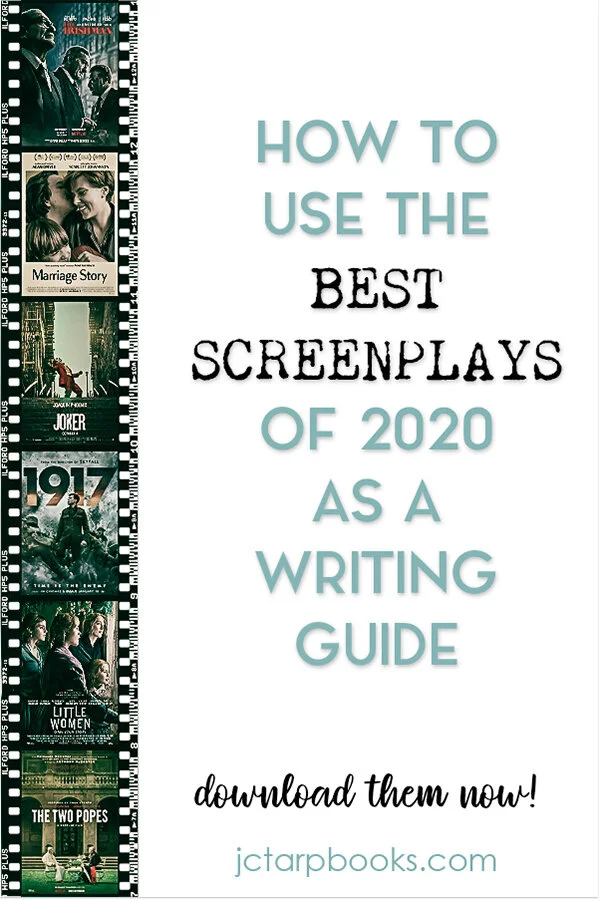
Studios and production companies and even some screenwriters will make scripts available for download for a period of time. And during awards season, it’s the best time to grab them as they make them available for consideration. So, here’s a list with links to download some of the best from this year.
A Beautiful Day in the Neighborhood
Harriet (Shooting Script)
How to Train Your Dragon: The Hidden World
Joker (Final Shooting Script)
Midsommar (Shooting Script)
The Irishman (Shooting Script)
The Aeronauts (Shooting Script with Revisions)
The Last Black Man in San Francisco
The Two Popes (Shooting Script)

Here’s what it looks like when I procrastinate: Some of my favorite songs reimagined as book covers.
SCREENWRITING:
How to use the best screenplays as a writing guide. Download your favorites to use as a resource tool.
SCREENWRITING:
What’s a logline and why do you have to have one? What are the key elements that make up the perfect logline?
Figure out which of the 7 common plotlines your story falls under so you can let your characters loose to start their journey.
You’ve written the last sentence on your first draft (or second or third). Your baby is done. It’s a blockbuster waiting to happen. But, is it?
A script analysis is a vital step.
Before you start revisions or seek coverage or editing, you need an expert set of eyes that read the way a studio, production company or literary agency would with invaluable notes along the way to make sure you’re on the right track.
PACKAGE INCLUDES:
Line–by–Line Editor's Notes
No Page Limit Report
Notes on Hook, Setting and Descriptions, Dialogue, Character Development and Growth, Plot, Pacing, Story Development including Story Arcs, Structure, and Marketability
Once you finally receive a request for your screenplay, you may think that it will go straight to the top. It doesn't. A "reader" snags it first. Whether it's an assistant or someone specifically tasked with reading stacks and stacks of scripts each week doesn't matter - it needs to be in the best shape possible to stand out from the crowd.
Know exactly what a studio, production company, or agency reader will say about your script before you start the submission process.
It's one of the most valuable tools that a screenwriter can have.
Let years of expertise and experience give you a leg up.
PACKAGE INCLUDES:
Logline
Synopsis
No Page Limit Notes on Market Potential, Main Plot, Sub Plot, Story & Character Development, Dialogue, Premise, and Structure
Ratings Grid
Grade - Pass, Consider, Recommend
The most comprehensive package. Not only do you receive proofreading and copyediting, but industry-standard coverage as well.
Is the story itself enough to hold the reader's attention and keep them engaged? Can they relate to the characters? Did you build your world enough? Is it plausible? Are there glaring holes in the plot? Does anything take the reader out of your story?
Package Includes:
Proofreading: Typos, Spelling, Grammar, Structure, Punctuation, and Syntax Errors, Notes on Accuracy and Consistency
Copyedit: Line-by-Line Notes and Edits, Word Choices – Tense, Unnecessary, Repetitive, Rhythm, Connotation, and Modifiers, Phrasing – Awkward, Transitional, Conciseness, Genre-Specific Notes on Story Flow, Continuity, Sluglines, Character Detail, Accuracy, Clarity, Style, Tone, Ideas and Concepts, Consistency, Format, Structure, and Denotes any Confusion
Coverage: Synopsis, No Page Limit Notes on Market Potential, Main Plot, Sub Plot, Story & Character Development, Dialogue, Premise, Structure, Ratings Grid, Grade - Pass, Consider, Recommend
A copyedit gets into the nitty-gritty of your screenplay to point out and remove anything that hinders or enhance anything that helps your words and story shine. You want the clearest story to give to your readers so they move your script to the top of the “recommend” pile.
Beyond the typos, bad grammar, and spelling mistakes, copyedits go page by page to catch run-on sentences, passive versus active, and any issues with phrasing, repetition, and rhythm.
Copyedits also spot any inconsistencies. Does the tone change periodically? Is your character’s name Michael at the beginning and Michah later? Are they removing a scarf twice? Did a sudden passage of time happen? Are they on the phone but you haven’t shown that? Does your slugline not reflect the scene?
This will catch anything that will take your reader out of the story.
Package Includes:
Line-by-Line Notes and Edits
Typos, Spelling, Grammar, Sentence Structure, Punctuation, and Syntax Errors
Word Choices – Tense, Unnecessary, Repetitive, Rhythm, Connotation, and Modifiers
Phrasing – Awkward, Transitional, Conciseness
Genre-Specific Notes on Story Flow, Continuity, Sluglines, Character Detail, Accuracy, Clarity, Style, Tone, Ideas and Concepts, Consistency, Format, Structure, and Denotes any Confusion
Screenwriters are creative. We pour our hearts out on the page and bring amazing things to life. We want to suck a reader in and keep them there—to envision our story on the big screen. We also get so engrossed in our own worlds that we overlook things and the fastest way to turn a reader off or take them out of your story is with basic grammar, typos, punctuation, or consistency issues.
This is the fastest turn off to a reader. If you can’t be bothered to make sure everything is perfect, why should they bother to read it?
If you feel your script is at it's peak, this is the last thing you should do before querying producers and agents.
Package Includes:
Typos, Spelling, Grammar, Structure, Punctuation, and Syntax Errors
Line-by-Line Notes and Edits
Notes on Accuracy and Consistency and Denotes any Confusion
As writers, ideas for scripts come and go as often as Batman is portrayed by a new actor.
Treatments are a great way to go about getting your story out without the labor of an entire feature script. Many companies and agencies will request one before they ask for a full screenplay as well.
Package Includes:
Logline
Comprehensive and In-Depth Notes and Suggestions on Viability and Marketability, Structure, Story and Character Development
Ratings Grid
Grade – Consider, Recommend, Pass
If there's no story, there's no movie. Taking something you see in your head and translating it into a screenplay is one of the hardest parts of the writing process. Creating three Acts, making sure the plot is constantly moving towards the end goal, using characters to propel it forward - these are but a few things that must be constant at all times.
Does your plot move at a good, smooth pace? Is it fleshed out enough to hold the reader's attention? Does it arc and climax in all the right places? Did you throw a deus ex machina in there just to get your outcome?
Make the story unforgettable before you send it in.
Package Includes:
Logline
Synopsis
Comprehensive, In-Depth Notes and Suggestions on Story Development, Action, Conflict, Resolution, and Continuity
Characters drive your story. They bring it to life. If you have lifeless characters and a fantastic story, it doesn't go anywhere. The way they look, their actions, their dialogue, and even their history, matters in propelling your story forward.
Fully-developed, rich characters are the backbone of your script. Make sure your characters do their job, resonate with readers, and make them want to read more.
Package Includes:
Comprehensive and In-Depth Notes and Suggestions on Character Development, Growth, Relatability/Connection, Dialogue, Action, Conflict, Resolution, and Continuity
Purchasing this digital gift card creates a unique code. The gift card recipient can enter this code at checkout to subtract the gift card value from their order total.
This gift card never expires.
Tips for creating a writing schedule that works with your everyday life.